Reflections on the Rosary of the Virgin Mary
Руслан Исламов · · Series: Наедине с душой
Today, the Catholic Church celebrates the feast of the Virgin Mary of the Rosary, dedicated to the apparition of the Virgin Mary to Saint Dominic in 1214, who was revealed the prayer that has become traditional in Catholicism today; it is the very prayer on the beads. The Catholic Rosary should not be confused with Orthodox prayer ropes, as there are nuances: one hundred knots, typically read only by monks (in many parishes laypeople are forbidden to read them, whereas in Catholicism the Rosary prayer is encouraged even for children), and in Orthodoxy, the "Jesus Prayer" is recited on them, whereas on Catholic beads, several basic prayers are recited (see image).
But today, I would like to talk not about this; or not solely about this. We are interested in the combination of faith and knowledge.
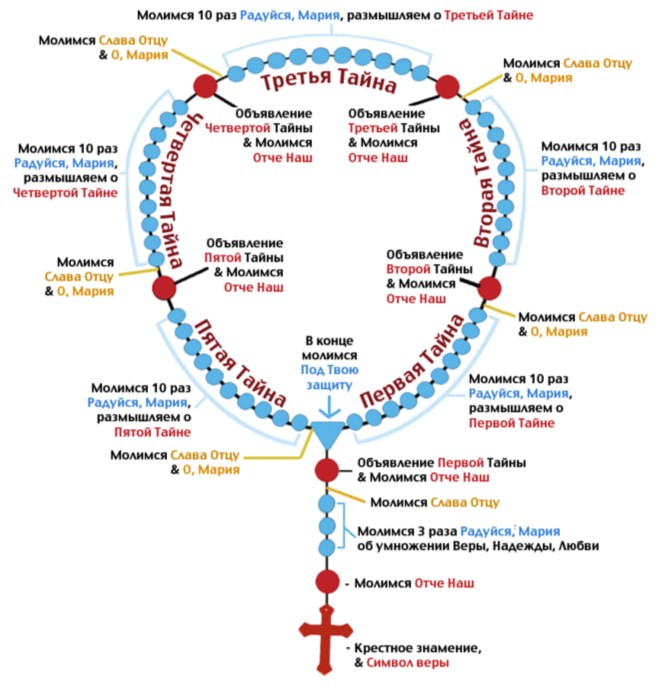
Image borrowed from posolstvolyubvi.com.
I am the most typical person of the modern era, whether I like it or not. It is difficult for me to accept something on faith and do it just because someone said so; I need some convincing rational explanation, or, albeit inexplicable, practical benefit. There are many of us like this, and it is quite normal for our time.
From the very beginning of my journey, it was difficult for me to take any religious prayers seriously, especially those with a clear structure and rigid form. I am very happy for people who are capable of unconditional faith, but I myself am "burdened" with rationalism, even being an idealist ("I want to believe, but it is hard to believe").
Since by the time I began my acquaintance with the Lord, I was already on the path of studying analytical psychology, the Rosary prayer immediately attracted my attention, even from a sceptically scientific point of view. I saw good potential in this prayer.
As has been mentioned repeatedly before, I belong to the Jungian school of analytical psychology. According to this approach, absolutely every person inherently possesses two "personalities" (I call them "personalities" figuratively, for simplicity of understanding): the ego-consciousness (the point from which we see the external and internal world), and the unconscious (everything that influences our states, emotions, thoughts, behaviour, etc.; everything we can only suspect but are unable to fully detect and analyse with the ego-consciousness).
The modern person is fanatically immersed in ego-consciousness, sincerely believing that they know themselves well, understand their nature, and control their soul. Our culture actively supports this. We arrogantly indulge in our thoughts and emotions as our own "achievements", and completely lose contact with our unconscious "consciousness".
And the unconscious is very "offended" by this, creating many psychological, and often even physical, troubles for us, the nature of which we are technically unable to understand ("I don't know what came over me", "the tests are good — but it still hurts", "I never thought I was capable of such a thing"). It (the unconscious) might not want to punish its "pilot-consciousness", and in this sense, it can be said that it is not the unconscious that creates such obstacles for us, but we ourselves run into them, refusing to listen to our notorious inner voice (and this is not only conscience and intuition, although it fully includes them).
The Rosary prayer, like any eastern mantras, is a powerful tool in reconciling the ego-consciousness with the unconscious. Let's briefly start with how the Rosary is recited.
First, as indicated in the image above, the praying person "enters" the prayer through the sign of the cross and the reading of one of the basic Catholic prayers "The Apostles' Creed"; then "Our Father" is recited and "Hail Mary" three times for "the increase of faith, hope, and love". During these four prayers, the reader is essentially preparing their ego-consciousness for a waking sleep. Then the Rosary prayer itself begins.
Earlier, I already wrote about imagination; our fantasies and dreams are the most powerful working tools of the unconscious, through which it has the opportunity to communicate with us (i.e., with our ego-consciousness) directly.
However, thanks to our "caring" ego-consciousness, the effectiveness of these tools is greatly reduced: dreams are sent in search of dream books, and imagination is branded as "just fantasies". The latter, moreover, is often forcibly subjected to self-censorship and suggestion; the incessant swarm of thoughts and prejudices presses imagination against a concrete wall, cutting it off like on a Procrustean bed. Eastern monks already understood the deceitfulness of the illusory world, the main source of which is human evaluative material thinking.
Fortunately, this very "thinking" (although it is more correct to call it quasi-thinking) — like everything artificial and pompous — has very limited resources; ego-consciousness is very easily overloaded (which modern marketing companies actively exploit, for example). No matter how impulsive and restless the victim is — the application of several sources with an active signal at once sends the ego into a knockout. This is exactly what we need.
For the unprepared reader, it will sound strange and even wild, but true awareness is the ability to consciously subordinate consciousness to the unconscious. 🤷🏻♂️
But let's return to the beginning of the prayer. As can be seen in any Rosary instruction, every 10 small beads (between 5 large ones) are divided into certain "Mysteries", of which there are also 5. First, technically on the beads: on the small beads, "Hail Mary" is recited, a total of 50 times (apart from the 3 at the very beginning), and on the large ones between them "Our Father". It's quite simple: these prayers, like their order, never change. They are repeated one after another, like a mantra.
As some readers may have already guessed, all the most interesting is contained in the mysteries: these are five biblical scenes from the life, death, and resurrection of Jesus Christ; on different days of the week, the prayer is recited over five scenes from five different time periods (the period from the birth to the youth of Jesus, the passion and crucifixion, the resurrection and legacy of Christ, and — a relatively recent addition — the period from the baptism of Jesus in the Jordan to the Last Supper; this mystery was introduced by John Paul II).
For example, on Fridays, the so-called "Sorrowful Mysteries" are recited — five scenes from the period of Christ's passion: the prayer in the Garden of Gethsemane, the scourging of Christ, the crowning with thorns, the way of Jesus with the cross to Golgotha, and the crucifixion itself.
More about the mysteries and the Rosary can be read here.
What do we have in the end? We recite 55 identical prayers, not counting the three introductory ones. Each large bead marks the beginning of a new scene; in our example — the first reading of "Our Father" is the beginning of the plot "prayer in the Garden of Gethsemane". Reading the subsequent ten "Hail Marys", we reflect only on this piece. For this, at the very least, one needs to read about the Gethsemane prayer in the Gospels and even better if fragments from films about Christ remain in memory (the greatest film of all time by Mel Gibson "The Passion of the Christ" begins precisely with the scene in Gethsemane).
In some prayer books, under each part, the "fruit of the mystery" is indicated — the heart of the reflection (for example, the prayer in the Garden of Gethsemane has the fruit "obedience to God's will"), although focusing on the proposed fruits is worth doing only at the very beginning of this practice; later, it is worth letting go of the theme from the prayer book and allowing the mystery to reveal the relevant internal unconscious aspect for the praying person.
I will never forget how I tried to "properly" recite the Rosary for the very first times: you repeat the prayer over and over, while trying to paint the biblical scene in your imagination, and somehow attach a useful conclusion, "the fruit of the mystery". It's simply unbearable, because where then to put thoughts about the loud truck passing by outside and the children screaming wildly on the playground? How then to reflect on how the cashier looked at me disdainfully in the morning at the store, and what will be for dinner today?
As in any meditation — at the very beginning, there is a real internal hell. At this stage, many believers allow weakness — making their Rosary reading purely mechanistic. No, focusing on repeating the same lines already gives a good effect, as at least for half an hour the chaotic thought flows of the ever-buzzing ego-consciousness are "silenced", and this gives the unconscious a little time to work on us in mental calm.
However, when the praying person manages to subordinate this silence to calm and measured internal observation of the images that imagination paints, the results can be beyond any expected boundaries.
The unconscious finds it easier to speak to us through images, but often, as in the example with dreams, it selects them haphazardly, which is why we often wake up even more puzzled. However, when we give the unconscious a "theme", it immediately tries to extract those images that both align with the main theme of our visualisation and, through associative images, can convey important internal information to the ego-consciousness. The main thing is to see it.
By repeating prayers, especially when brought to automatism, we sort of lull the consciousness that constantly bombards us with unnecessary thoughts, unfounded evaluations, and judgments and does everything to keep us focused on our neuroses. At the same time, we remain in the room, and we can observe how the unconscious (see God's image within us) quietly sneaks into the bedroom of the ego-consciousness and tries to tell us something.
It is also worth paying separate attention to the physical action — namely, the fingering of the beads. Although many Catholic clergy say that the presence of the beads themselves is not necessary (after all, there are ten fingers on the hands), I still consider it important to note that "fingering" the beads (or the pads of the fingers) with the prayer is important not only to keep count but also as another source of "noise" for the ego-consciousness, on which it will have to throw all remaining forces, freeing even more space for the unconscious to work through imagination.
Of course, at first, it will be extraordinarily difficult. Especially if the praying person encounters these prayers for the first time; initially, they will naturally need to learn them to automatism, so that they can be recited if woken up in the middle of the night. But even after this, it will not become easier. The ego is not accustomed to giving place to anyone else but itself, just as a person does not hear God simply because they do not want to hear Him. Thoughts and judgments will relentlessly pour in and knock you off course. So it is.
Therefore, in such prayers as the Rosary, consistency, regularity, and perseverance are important. Got distracted? No problem: realised you got distracted, and returned to the prayer. I liked how one sister-nun explained her motivation to read the Rosary: to read it to "comb" her thoughts.
And in this series of publications, I have deliberately not said a word about how the Lord acts through prayer from a "religious" point of view. But, firstly, much is already written about this on Catholic resources today in connection with the feast, and secondly, as it seems to me, there is enough information for today. I will only say this.
The problem with such prayers lies in "habitualness": believers in these reflections focus too much on dogmatism and are unable to see what God truly wants to convey to them; non-believers approach this with arrogant scepticism, often belittling the significance of their own imagination, and thus their internal contents. Ultimately, both sides suffer equally. The Lord always adheres to the golden mean.
"We must read the Bible, otherwise we will not understand psychology. Our psychology, life as a whole, our language and imagery are based on the Bible" Carl G. Jung, The Visions Seminars, part 1, p. 156.
See you soon. The Lord be with you.