Discipline of the Spirit II. The Mechanism of Testing.
Руслан Исламов · · Series: Наедине с душой

Capitulum II. The Mechanism of the Methodology
At the very beginning, I choose a "little sin" (preferably not too ambitious; while I could choose "anger" or "lust", it is better to start with something more specific that manifests itself as often as possible each day: irritability, nervousness, intrusive thoughts; perhaps you often chew on a pen, or like me, you constantly swear, using filler words).
Then, I need to get a separate notebook. You could use an A4 sheet for each week, but personally, I would recommend getting a notebook that is always kept in one place at home/car/jacket; I always know where it is, that this notebook is exclusively for the testing, and — importantly — my testing takes on the characteristics of a ritual (and our subconscious loves rituals, that’s just how our psyche is structured).
I set three alarms on my phone throughout the day: at 12:00, 18:00, and 22:00. You can play around with the times, setting more convenient hours (perhaps you work at night and sleep during the day). The main thing is to have an even distribution throughout the day (at the end of each third of wakefulness) and consistency. Those accompanying in the Spiritual Exercises allow for a conscience test once a day; St. Ignatius tested himself five times in the first half of the day; from my personal experience, three times a day is just right.
On the left side of the page, we write the name of the sin being examined, and from it, we draw a line on which we will place dots (or crosses, as you wish) where the transgression occurred. Ignatius recommends writing a large letter G to denote Sunday, and below a smaller G for Monday, and so on. This way, the test-taker has a clear visual representation of the entire week. Over time, I started taking 2-3 (and now 5) sins for testing, so it’s easier for me to divide the page into seven squares for the days of the week, roughly allocating time at the top (morning, day, evening). Below, I will attach a photo example from my notebook to make it clearer.
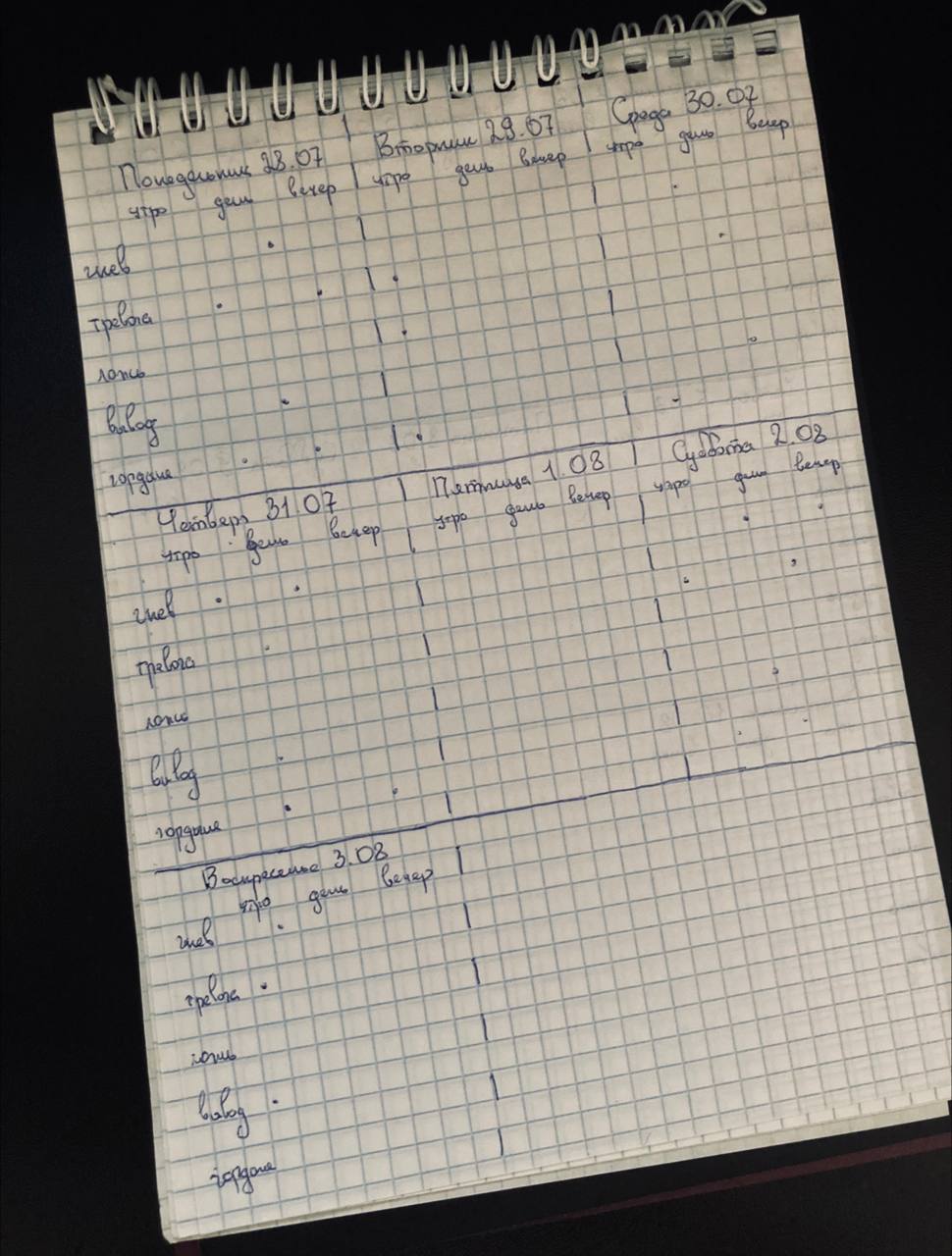
Ignatius also recommends that each time a sin is committed, one should place a hand on the chest. This allows one to "not draw attention" from outsiders, while also providing an associative hook for the subconscious. It will be much easier to remember approximately when and under what circumstances the "slip" occurred.
The first test begins immediately upon waking. If my worldview allows me to turn to God, I ask Him to help me rid myself of the designated transgressions; otherwise, I simply slowly and attentively reconsider what I want to eradicate from myself and mentally set my intention. "May today ____ become less".
The second test should be conducted after lunch; I would say this test is one of the most important during the day, as we examine ourselves during the most "unbalanced" part of the day. Meeting with colleagues in the morning at work, planning sessions, first classes or lessons — it’s still difficult to mobilise my attention and "put on an acceptable mask".
Important! And I will write about this more than once: I do not try to restrain or control myself. My only task is to observe myself as attentively as possible and remember. There will be a temptation to record each sin in notes at the moment of its commission, but — no, it’s not worth it. I place my hand on my chest and remember. Yes, I regret it, but I do not judge or scold myself. I simply fix it and keep the intention in mind, and then I note it down.
There are times when it’s not possible to open the notebook and place dots according to the alarm; in such moments, I take out my phone and place stars in my notes; when the opportunity arises — I rewrite from there into the notebook (which allows me to recall and review the circumstances of the "sin" once more). The main thing is to do this only at the designated time, otherwise, "hello, neurosis".
And that’s it. Nothing complicated or outstanding.
What conclusions and observations I have made while practising the examination of conscience, as well as what Carl Jung thought about this, we will discuss in the next publication. I could have described the methodology more briefly if I had used excerpts from the "Exercitia Spiritualia", but the only decent translation into Russian is prohibited from copying without permission (which will take some time).